Calgary’s housing market has put many homeowners in a difficult position. Bidding wars, limited inventory in desirable neighborhoods, and the hassle of uprooting your family make moving feel like the hard option. That’s why so many Calgarians in communities like Tuscany, Mahogany, and Altadore are choosing a different path—expanding their existing home instead of leaving it behind.
A well-planned house addition lets you create the extra space your growing family needs while keeping everything you already love about your neighborhood, your commute, and your kids’ schools.
Fast Overview: Are Calgary Home Additions Right for You?
The decision to add on rather than move comes down to practical math for most Calgary families. When you factor in land transfer taxes exceeding $10,000 on median home sales around $600,000, realtor commissions typically at 7%, and the stress of competing for limited listings, staying put and building out starts to make serious financial sense.
Calgary’s school catchment system—where both public and Catholic districts assign students based on home address—adds another layer to the equation. A move across the city could mean pulling your kids out of schools they’ve attended for years.
Here’s a quick breakdown of what Calgary homeowners are building in 2025:
Basement finishes – Transform an undeveloped basement into livable space without any exterior changes
Second-storey additions – Build up when your lot can’t accommodate building out
Kitchen bump-outs – Extend a single wall by 2-8 feet to create room for an island or breakfast nook
Attached garages – Add parking, storage, and a weather-protected entry
Legal secondary suites – Generate rental income with a code-compliant in law suite featuring a separate entrance
Typical 2025 Calgary price ranges:
Major full-size additions: $60,000–$120,000 at $250–$450 per square foot finished
Basement developments: Starting at $35,000+ for roughly 800 square feet at $70–$100 per square foot
Average timelines: 8–20 weeks depending on scope and season
Calgary-specific benefits worth considering:
Stay within your current school catchment zone
Avoid land transfer taxes and realtor commissions that can total $50,000+
Work within established neighborhoods where new lots simply don’t exist
Navigate tighter infill lots and RC-1/RC-2 zoning with experienced local help
Retain proximity to LRT lines, pathways, and amenities you already rely on
Popular Types of Home Additions in Calgary
Calgary’s housing stock splits roughly into two categories: pre-1990s bungalows and split-levels in inner suburbs, and post-2000 two-storeys spreading south and east. The type of home addition that makes sense for your property depends heavily on which category you fall into—and how Calgary’s climate affects your building options.
Full-size rear or side additions – Major extensions of 15-30 feet that add significant square footage for great rooms, expanded kitchens, or main-floor primary suites
Second-storey additions – Popular on bungalows where lateral expansion isn’t possible, adding 800-1,500 square feet with 3-4 bedrooms above
Bump-outs – Modular 2-8 foot extensions minimizing foundation work while creating more functional space in kitchens or bedrooms
Sunrooms and 3-season rooms – Glass-heavy additions leveraging Calgary’s 2,300+ annual sunshine hours while managing extreme temperature swings
Basement developments – Converting underutilized 700-1,000 square foot spaces into family rooms, guest suites, or rental units
Attached and detached garage conversions – Repurposing 400-500 square foot structures into heated offices, studios, or secondary suites
Climate factors that shape Calgary additions:
Snow loads up to 2.4 kPa requiring engineered roof trusses
Winter temperatures dipping to -30°C demanding high R-value insulation and heated enclosures for off-season construction
Hail events with stones up to 4 cm diameter affecting glazing choices
Frost depths of 1.2 meters requiring foundations extending well below grade
118 annual snowfall days compressing the optimal construction season to April-October
Later sections will break down costs, permits, and planning considerations for each addition type.
Full-Size Rear & Side Home Additions
Full-width rear additions are common renovation projects in Calgary’s established 1960-1990s neighborhoods. Communities like Varsity, Dalhousie, and Lake Bonavista are filled with homes where original footprints maxed out lot coverage decades ago—leaving vertical or rear expansion as the only practical path to more room.
These additions typically involve demolishing an existing wall to extend 15-30 feet, creating the kind of open-plan living that modern families expect but older floor plans rarely deliver.
Typical uses for rear additions:
400-600 square foot great rooms with vaulted ceilings flowing into expanded kitchens
Kitchen and dining room combinations with 10-foot islands accommodating 8-10 seats
Main-floor primary bedroom with spa-style ensuite bathroom
Hybrid home office doubling as guest space with murphy bed or built ins
Structural requirements specific to Calgary:
New frost walls excavated to 1.2-1.5 meters below grade
Poured concrete grade beams spanning under party walls
Engineered wood or steel trusses rated for 21 psf ground snow load plus 15 psf rain load
Sistering existing rafters and chemical anchoring bolts every 4 feet where new meets old
Tie-in to existing foundation requiring careful engineering assessment
Realistic 2025 cost guidance:
$250–$450 per square foot finished, with the range reflecting builder-grade finishes on the low end versus custom millwork and smart home integration at the top
Total project costs typically land between $120,000 and $300,000+ for 500-800 square feet
Budget breakdown: approximately 30% labor, 25% materials, 10% permits and design, 15% contingency
A 500 square foot rear addition in Lake Bonavista with quartz counters and hardwood recently came in at $175,000 ($350/sq ft)
Average timelines:
14–24 weeks from design through final inspection
4-6 weeks for design and permits through Calgary’s online portal
2-3 weeks for demolition and foundation work
6-10 weeks for framing and building envelope
2-4 weeks for finishes and inspections
Design considerations for seamless integration:
Matching existing brick or hardy plank siding to avoid a patchwork appearance
Aligning roof pitches (often 4/12 to 6/12 in Calgary homes)
Selecting windows from the same manufacturer family as existing
Staying under 45% lot coverage as required by Calgary’s Land Use Bylaw
Avoiding Development Permit denials by respecting streetscape rhythm
Second-Storey Home Additions in Calgary
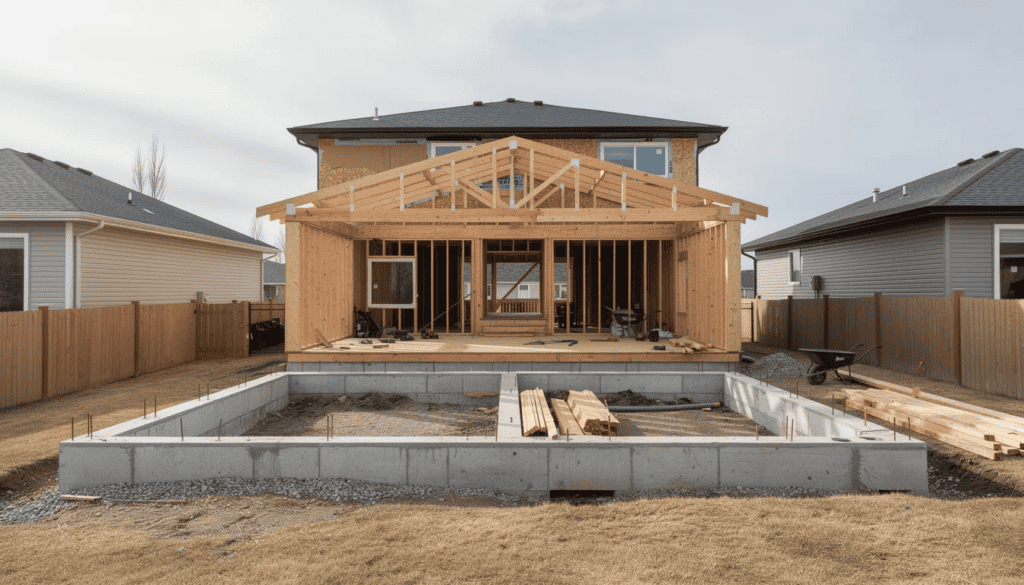
Building up makes sense when building out isn’t an option. In older bungalow communities like Haysboro, Brentwood, and Acadia, lot sizes of 60×110 feet limit lateral growth—but the views of the Rockies or Bow River valley from a new second floor can be spectacular.
A story addition on a single-storey home can add 1,000-1,800 square feet of new space while preserving your backyard and staying within lot coverage limits. It’s a popular choice for families who’ve outgrown their bungalow but don’t want to leave an established neighborhood where similar homes are selling for premium prices.
Calgary’s demographic trends reinforce this approach. With roughly 25% of the population over 55 according to 2021 census data, multigenerational living arrangements are becoming more common. A second storey can accommodate adult children, aging parents, or both—especially when designed with universal features like wide hallways and accessible bathrooms.
Typical second-storey layouts:
2-4 bedrooms including a primary suite with ensuite and walk-in closet
2-3 full or three-quarter bathrooms
Upper laundry closet with stackable units eliminating basement trips
Bonus room or dedicated space for a home gym, entertainment area, or home office
Sometimes a small balcony or deck off the primary bedroom
Structural realities you need to understand:
Full Phase 1 structural assessment required to evaluate foundation capacity
Original strip footings often need upgrading to 12-inch thickened slabs
Beam replacements with LVLs or glu-lams to carry the new load
Shear wall retrofits with plywood sheathing for 90 mph wind resistance
Roof removal via crane exposes the shell, requiring temporary weather protection
Ballpark 2025 costs:
$300,000–$600,000+ for a full second storey with complete interior finish
Approximately $300-$400 per square foot depending on finishes
Major cost components: $50,000 foundation work, $100,000 framing and roofing, $75,000 mechanicals including HRV for air quality
Flooring typically luxury vinyl or engineered hardwood for durability and moisture resistance
Disruption and relocation:
Most families need to move out for 3-6 months during roof removal, framing, and tie-in work
Budget $15,000-$30,000 for short-term rental accommodations
Total disruption is greater than any other addition type
Zoning and height limits:
Calgary’s Land Use Bylaw caps height at 10 meters (32.8 feet) in many RC-1L districts
Dormers cannot encroach into front setbacks of 6 meters
Height is measured from grade, so sloped lots require careful calculation
Contextual Development Permits may be required in some inner-city areas
ROI considerations:
Second storey additions can deliver 70-90% ROI through added legal suites or additional bedroom and bathroom combinations
Risks include differential settlement if new and old foundations don’t match properly
Extended timelines of 24-36 weeks during peak season due to inspector backlogs
Room Additions, Bump-Outs & Sunrooms
Not every home addition needs to be a major construction project. In master-planned suburbs like McKenzie Towne, Coventry Hills, and Evergreen, many homeowners are looking for targeted improvements—a single room that solves a specific problem without the complexity of a full rear extension.
Bump-outs explained:
Project 2-8 feet beyond the existing footprint
Often cantilevered over existing foundations using steel I-beams or helical piles
Ideal for kitchen bump out additions that create space for a pantry, larger kitchen island, or bay window dining nook
Can expand a small bedroom to accommodate a proper closet or seating area
Minimal disruption at 6-10 weeks compared to major additions
Sunrooms and 3-season rooms:
Glass-heavy additions designed to capture Calgary’s 333+ sunny days per year
3-season versions (unheated, R-10 walls) use aluminum frames and single low-E glass
3-season sunrooms typically cost $30,000-$70,000 for approximately 200 square feet
Four-season heated rooms with insulated structural panels (R-20+), radiant floors, and gas fireplaces start at $80,000+
Best oriented south for passive solar gain that can offset heating costs by up to 20%
Cost ranges for Calgary:
Kitchen bump-outs: $70,000-$120,000 including cabinet relocation and plumbing tie-ins
Simple 3-season sunroom addition: $30,000-$70,000
Fully heated four-season sunroom: $80,000-$150,000+
Planning factors specific to Calgary’s climate:
West-facing sunrooms can overheat above 30°C in July without proper shading
Deciduous trees or automated blinds help manage solar gain
Triple-pane low-E windows with U-factor of 0.20 or better recommended for -30°C performance
Overhangs and exterior shading prevent summer overheating while allowing winter sun while you coordinate interior choices with modern interior design styles for home renovations
Code distinctions to understand:
True living space requires 2.1m ceiling heights and R-20 below-grade insulation
Unconditioned sunrooms can use R-12 insulation per National Building Code Part 9
Seasonal additions have different mechanical requirements than year-round space
Connection to main house affects how the space is classified for permits
Challenges and benefits:
Moisture ingress from hail-impacted glazing is a risk in Calgary
Solar tube failures can occur in extreme temperature swings
Quick 60-80% ROI for lifestyle upgrades that enhance daily living
Creates inviting space without the complexity of foundation work
Basement Developments & Garage Conversions in Calgary
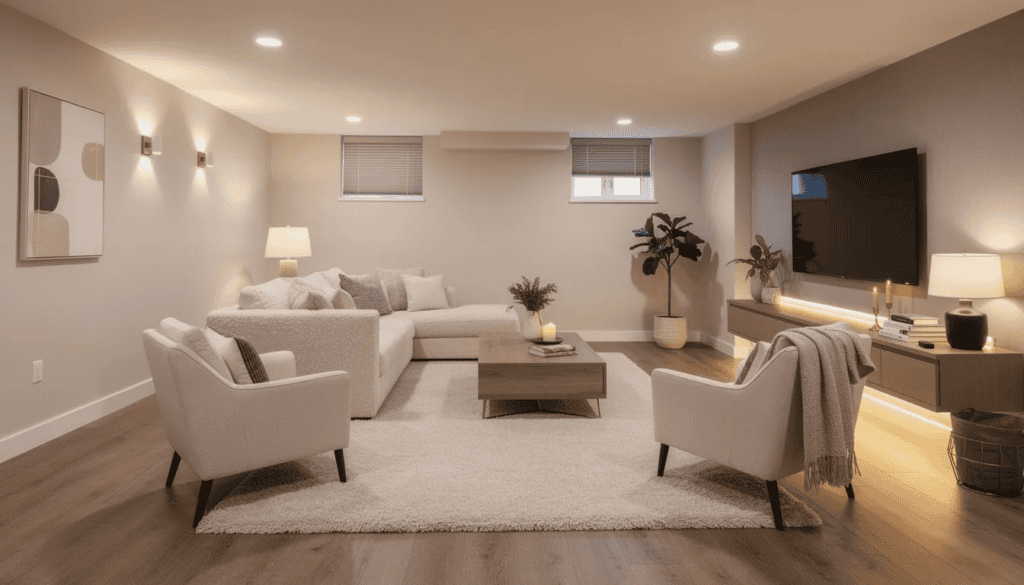
Finishing an undeveloped basement is often the most cost effective way to add floor space in Calgary. Most homes built after 2000 include daylight basements with 800-1,200 square feet of raw space just waiting to become functional space.
With Calgary’s rental vacancy rate around 4.5% and average one-bedroom rents hitting $2,000 monthly in 2025, a legal secondary suite in your basement can generate serious income while adding extra living space for your household.
Typical basement development layouts:
Open family room with 55-inch linear fireplace
Guest bedroom with code-compliant egress windows
Full 3-piece bathroom
Wet bar with undercounter fridge and sink
Home gym with rubber flooring
Legal secondary suite with kitchenette, separate metering, and soundproofing
2025 cost guidance for Calgary:
Standard basement development: $35,000-$90,000 ($70-$100 per square foot)
Basic recreation room without bathroom: approximately $40,000
Full legal secondary suite including plumbing stacks: $70,000-$120,000
Budget approximately $15,000 for plumbing rough-in if adding a bathroom or kitchenette, and compare these figures with a broader cost overview of residential renovations in Calgary to see how additions fit into your total plan
Calgary building codes requirements:
Minimum 2.0m ceiling height after drop ceiling or drywall installation (accounting for 8-inch joists)
Egress windows must have minimum 0.8 square meter opening with sill no more than 1.0m from floor
R-12 below-grade rigid foam insulation required
NFPA 13D sprinklers required in secondary suites
HRV providing 50 CFM fresh air for air quality
Radon sump pits recommended given 15% regional prevalence
Garage conversion considerations:
Typical attached garage of 20×22 feet provides 440 square feet of potential new room space
Common in communities like Ogden and Forest Lawn where lot sizes support alternative parking
Requires insulated slab (R-15), solid wall replacing overhead door, and mini-split heating for -30°C operation
Costs typically $50,000-$80,000 for full conversion to heated living space
Challenges with conversions:
Slab moisture issues require dimple mat drainage solutions
Asbestos in pre-1980 ductwork may require professional remediation
Converting your only garage may violate parking bylaws unless tandem or street parking is available, and some homeowners instead invest in luxury garage upgrades and custom garage renovations in Calgary to enhance existing spaces
Additional bedroom without proper egress creates safety and code issues
ROI potential:
Legal secondary suite yielding $1,500-$2,000/month can deliver 100%+ ROI over time
Basement family rooms add lifestyle value but lower percentage return at resale
Finishing a new space in your basement is typically half the cost per square foot of above-grade additions
Calgary-Specific Permits, Zoning & Regulations
Calgary’s rules for additions and secondary suites are more stringent than many smaller Alberta communities. Understanding the permit process early—before you finalize design or commit to a contractor—can save you months of delays and thousands in redesign costs.
Key approvals you’ll need:
Development Permit – Required for variances such as 1.2m side setback relaxations in RC-1 districts, contextual reviews in Direct Control areas like Crescent Heights, or any encroachment into required setbacks ($500-$2,000 fee if triggered)
Building Permit – Required for all structural work, typically $0.15-$0.25 per square foot based on project valuation (approximately $5,000 for a $300k project)
Trade permits – Separate permits required for electrical ($300), plumbing ($400), gas, and HVAC work
Land Use Bylaw 1P2007 basics:
RC-1 (low-density residential) limits lot coverage to 45% and height to 10m
RC-2 (grade-oriented infill) allows up to 52% lot coverage and 12m height with grade orientation requirements
Setback requirements vary by district—typical front setback is 6m, sides can be 1.2m or contextual
Writer note: Verify current code sections as bylaws are updated periodically
When Development Permits are required:
Encroachments into required setbacks
Contextual rule compliance in heritage or character areas
Relaxation requests for lot coverage or height
Any addition in Direct Control districts
Changes visible from public streets in some inner-city communities
Legal secondary suite registration:
All secondary suites must be registered with the City of Calgary
Registration fee is currently $200 (earlier fee reductions to $100 have ended)
Suites require fire alarms tied to mains, 10% lot setback for separate entries
Separate metering required for landlord billing
Fire separation and soundproofing (STC 50+ walls) must meet code
Special considerations for Calgary properties:
Corner lots require 3m flanking setbacks
6m buffer required from utility rights-of-way
Post-2013 overland flood drainage regulations affect how additions can alter water flow
Heritage Bylaw 5P81 applies in areas like Cliff Bungalow and Crescent Heights, mandating reversible materials
Pre-1970 homes may trigger additional requirements for asbestos and electrical upgrades
Process tips:
Calgary’s eSubmittal portal handles most permit applications with 2-4 week turnarounds
Incomplete applications reset the clock—submit thorough documentation the first time
Stop-work orders for unpermitted work can inflate costs by 20% or more
Early consultation with a designer familiar with local regulations saves time
Planning Your Calgary Home Addition: Key Questions to Ask
Before you commit to any home addition project, step back and think beyond your immediate needs. The addition you build today should serve your household for at least 10-15 years—accounting for changes you can’t fully predict but can reasonably anticipate.
Questions about household growth:
Will you need an additional bedroom for future children or returning adult kids?
Are aging parents likely to move in, requiring main-floor living or an accessible in law suite?
Could your household shift to multi-generational living within the next decade?
Do you anticipate permanent work-from-home arrangements requiring a dedicated space?
Budget and financing considerations:
How much equity do you have available for a HELOC or cash-out refinance?
With Bank of Canada rates projected at 3.5-4% in 2025, what monthly payment can you sustain on borrowed funds?
Have you factored in the cost of temporary housing if your project requires moving out?
Is a 15-20% contingency built into your numbers for unforeseen issues?
Long-term value questions:
How will your expanded home compare to others on your street in neighborhoods like Killarney, Bowness, or Silverado?
Are you at risk of overbuilding for your area, limiting ROI at resale?
Will the addition add bedrooms or bathrooms—the features that most affect your home’s market value?
How long do you realistically plan to stay? ROI improves significantly if you hold for 5-10+ years
Lifestyle needs specific to Calgary:
Do you need a proper mudroom with space for ski gear, boots, and winter clothing?
Would a three-season outdoor living space extend your usable months in Calgary’s short summers?
Is better indoor-outdoor flow to decks and patios important to how you use your current space?
Do you need secure, heated storage for bikes, kayaks, or other gear?
Timeline planning:
Calgary’s optimal construction season runs April-October
Winter builds require heated enclosures, adding 10-15% to costs
Starting design and permits in fall positions you for early-spring construction starts
Peak-season contractor availability is tightest—booking early gives you more choices
Complex projects with structural engineering can take 4-6 weeks just for design and permits
Costs & Return on Investment for Calgary Home Additions
Per-square-foot costs in Calgary have risen roughly 45% since 2020. Labor shortages in skilled trades, material price volatility, and post-pandemic demand have all pushed numbers upward. Setting realistic budget expectations from the start prevents painful surprises mid-project.
Carpenter wages now run $45-$65 per hour in the Calgary region. Lumber costs remain 15-20% above pre-2021 levels. These aren’t temporary spikes—they represent the new baseline for adding square footage to your Calgary home.
Broad 2025 cost ranges for Calgary additions:
Basement developments: $70-$100 per square foot
Bump-outs: $200-$300 per square foot
Full main-floor additions: $250-$450 per square foot
Second storey additions: $300-$400 per square foot
Legal secondary suites: $180-$250 per square foot
Common budget line items to plan for:
Design and engineering (5-10% of budget): $15,000-$40,000 including structural stamps
Permits: $3,000-$7,000 depending on project scope
Demolition and structural work: $50,000+ for beam replacements and foundation tie-ins
Building envelope (framing, insulation, windows, roofing): $40-$60 per square foot
Mechanical changes (HVAC upgrades, HRV, plumbing): $20,000+
Finishes (flooring, cabinets, fixtures): varies widely based on selections
ROI patterns in Calgary:
Strongest returns on added bedrooms and extra bathroom combinations
Legal secondary suites can deliver 80-120% ROI in desirable areas when held 5-10+ years
High-quality kitchen renovation and expansion performs well in stable neighborhoods
Such additions typically recover 60-90% of cost at resale in areas like Killarney or Tuscany
Overbuilding relative to neighborhood comps limits returns
Timing affects ROI:
Selling within 1-3 years of a major addition often means losing money on soft costs
Staying at least 5-10 years allows appreciation and amortizes the investment
Rental income from suites can make an addition cash-flow positive within a few years
Contingency recommendations:
Budget 15-20% contingency for unforeseen issues
Pre-1970 homes frequently reveal knob-and-tube wiring requiring full replacement
Polybutylene pipes common in 1970s-1990s homes often need updating
Asbestos in vermiculite insulation adds remediation costs
Old foundations may need more extensive work than initial assessments suggest
Working With a Calgary Home Addition Contractor
Choosing the right contractor is arguably the most important decision you’ll make. A local team familiar with Calgary’s inspectors, suppliers, and climate details can navigate challenges that would trip up an out-of-area company. The relationship you build with your contractor will shape whether your project is a smooth process or a stressful ordeal.
Key selection criteria:
Previous Calgary addition projects in neighborhoods similar to yours
References you can actually call—not just online reviews
Transparent contracts with clear scope, timeline, and payment terms
Documented change-order procedures so surprises don’t blow your budget
Experienced project managers who will work closely with you throughout
Verification requirements:
City of Calgary business licence in good standing
WCB Class A coverage protecting you from liability
Liability insurance with limits appropriate for six-figure projects (minimum $2M recommended)
Confirm the company is a properly insured company, not just a sole proprietor with minimal coverage
Contract essentials:
Detailed scopes of work specifying exactly what’s included
Allowances clearly stated for finishes like appliances, flooring, and fixtures
Fixed payment schedules tied to milestones (typical: 20% deposit, 30% at framing, 30% at rough-in, 20% at completion)
Clear cleanup and site-protection plans
Written process for handling the necessary permits and inspections, especially for more complex full home renovations and complete house remodeling in Calgary
Communication expectations:
Regular progress updates—weekly at minimum for active construction
Single point of contact on the contractor side
Defined process for raising concerns or requesting changes
Your design team should be accessible for questions throughout
Visualization tools:
Request 3D Revit renderings for complex kitchen expansions or second floor additions
Detailed drawings help you understand how the final result will look and function, particularly for major projects like modern kitchen renovations in Calgary
Virtual walkthroughs can reveal issues before they become expensive on-site problems
Even simple additions benefit from drawings that show how new space connects to existing
What to watch for:
Contractors who resist putting details in writing
Unusually low bids that suggest corners will be cut
Pressure to skip permits or “handle it later”
Poor communication during the estimate phase—it only gets worse during construction
The right expert team brings your vision to life without unnecessary drama

Next Steps: Getting Started on Your Calgary Home Addition
Adding on to your existing house can be more practical than competing in Calgary’s tight real estate market. You avoid the stress of bidding wars, keep your kids in their schools, and create exactly the spacious home your family needs—designed around how you actually live.
The path from idea to completed addition follows a logical sequence. Taking it step by step prevents expensive mistakes and keeps your renovation project on track.
Step-by-step path to your addition:
Define your needs clearly—what problem are you solving?
Set a realistic budget including 15-20% contingency
Gather inspiration photos showing layouts and finishes you like
Obtain a site survey confirming your lot dimensions and setbacks
Consult a designer or engineer to verify what’s structurally possible
Request detailed quotes from 2-3 qualified Calgary contractors
Timing considerations:
Aim to complete design and permits by late winter
Position construction to start at the beginning of Calgary’s April-October building season
Allow 4-6 weeks for permit processing through Calgary’s system
Book your contractor early—the best teams fill their spring schedules by January
The value of an initial consultation:
Review zoning requirements specific to your lot and district
Assess structural feasibility based on your existing home’s construction
Get a preliminary cost range before you commit to detailed design
Identify potential challenges early when they’re cheapest to address
Understand what’s possible within your budget before making final decisions
What to bring to your first meeting:
Photos of your existing space and the areas you want to expand
A rough idea of your budget range
Notes on how you use your current space and what’s not working
Any previous renovation project documentation (permits, surveys, drawings)
The best way to move forward is through careful planning and expert guidance. A Calgary-based design-build team with deep local experience can walk you through the entire process—from initial concept through final touches and inspection.
Ready to explore your options? Reach out for a no-obligation consultation where you can discuss your goals, review your property’s potential, and get a realistic preliminary cost range, or contact a Calgary renovation and design specialist directly to start planning. The right team will seamlessly integrate your new addition with your existing home, creating the extra space your family deserves without the upheaval of moving.